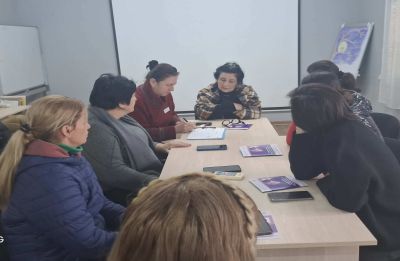
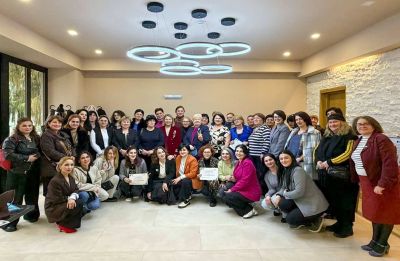


Spring is in our rehabilitation center—in the air, in the flowers in the courtyard, in the women's moods.
It's not visible in the photos, but we know how happy the women are; they share this with us, they appreciate our care, and express their gratitude.
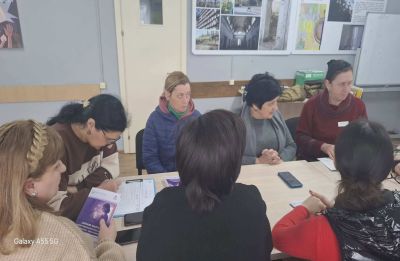
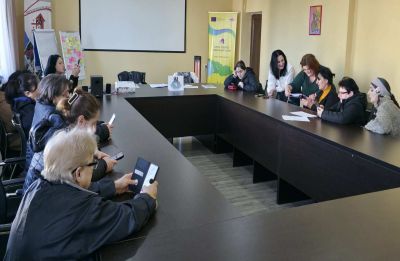
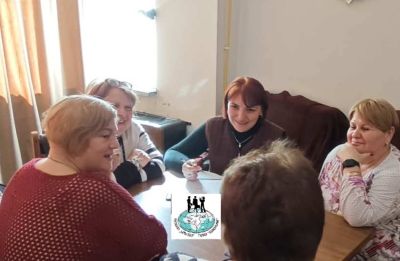
In one photo there is Eka Kvachakidze, the psychologist, whom the women trust most, share their problems and feelings with her, and receive the advice they need.
In the second photo a project coordinator Lela Jalagonia and project assistant Khatuna Gogua are talking to the women. Women are more modest with them, but they say they enjoy being at the center, the environment, the way they are treated, and that the children are also very happy...
The project is implemented with the support of the organization Brot
für die Welt - Evangelischer Entwicklungsdienst (Germany)

A woman shouldn't speak about her problems in public; she shouldn't speak publicly about family conflicts...
This is a stereotypical attitude toward violence. In such a situation, society becomes indifferent to women's problems.
Forum Theatre breaks these stereotypes...
Performances and active discussions clearly demonstrate to everyone that violence against women is a widespread problem and that women need protection, and that violence needs to be eradicated...
Forum Theatre held performances at Kutaisi Youth Center and in the central park. According to the audience, this way of presenting the problem is of great importance and serves to prevent violence.
The project is implemented with the support of the organization Brot
für die Welt - Evangelischer Entwicklungsdienst (Germany)
The video From Research to Action shows how the needs identified through the research conducted by the Women’s Fund “Sukhumi” were transformed into concrete civic initiatives. In this process, the voice of the community itself was especially important - each initiative was developed based on the needs, experiences, and visions of local residents.
The video illustrates how research was turned into action, and how the community became the main driver of change. The common goal of the initiatives was to mitigate the consequences of migration through local engagement and to create a support environment tailored to people’s needs.
The project is implemented with the support of the organization Brot
für die Welt - Evangelischer Entwicklungsdienst (Germany)

How actual is the problem of domestic violence in communities?
How informed is the public about victim support services?
How do they respond to cases of violence?
Where can they find information about existing services?
Active discussions on these issues were held at informational meetings initiated by the Women Support Centers of Khurcha (Zugdidi Municipality), Tskaltubo, and Tsalenjikha.
Paraprofessionals actively work with mobilizers to strengthen social work. In parallel with case identification, referrals are underway. Three women and their children will receive psychosocial support at our rehabilitation center.
Social work facilitates access to services, which is especially important for women at risk.
The project is implemented with the support of the organization Brot
für die Welt - Evangelischer Entwicklungsdienst (Germany)

One – year project aimed at strengthening social work in IDP communities has been successfully completed. The aim of the project was to study community needs, identify challenges, and support concrete initiatives.
In frames of the project, Senaki mutual assistance group implemented two initiatives. One of them involved the creation of an isolated eco-park with recreational toys. This is a comfortable and safe space for mothers and children.
Participants of the initiative assessed the project's impact using an online questionnaire. They noted a significant increase in community activity and engagement, which is considered a positive outcome. The women's group has plans for the future and believes that similar initiatives should be continued.
The project is implemented by a coalition of non-governmental organizations: the Association of IDP Women "Consent," the Women's Information Center, and Charity Humanitarian Women Fund “Sukhumi”.

This information guide for women joins practical and essential information on responding to cases of violence, available services, hotlines, shelters, legal and psychosocial support.
The aim of the guide is to help women, community leaders, and active citizens quickly obtain reliable information on ways of assistance and support mechanisms, as well as to learn about opportunities for economic empowerment.
The project is implemented with the support the Equality Fund (Canada)

The aim of the ordinary meeting of Kutaisi Women's Mutual assistance Group was to summarize the project's results.
During the meeting, participants spoke with particular emotions about the process of implementing civic initiatives that played a significant role in creating an atmosphere of trust and gratitude in the IDP community.
The group members emphasize that, despite positive changes, the communities still have numerous needs, so they try to use all available resources and address existing challenges.
The project is implemented by a coalition of non-governmental organizations: the Association of IDP Women "Consent," the Women's Information Center, and Charity Humanitarian Women Fund “Sukhumi”.

Members of the mutual assistance group and the Network of Women and Youth Peace Ambassadors attended the meeting in Khoni.
Participants summarized the project results and noted the importance of the training cycle for acquiring knowledge and skills. They spoke about civic initiatives implemented in the community and expressed gratitude to the Women Fund “”Sukhumi, partner organizations, and donors.
The women are proud and pleased with the results of their work. Their community has gained increased trust, and if the project continues, many women are willing to actively participate in identifying and addressing community issues.
According to members of both groups, much work still needs to be done and they look forward to further collaboration with the Fund “Sukhumi”.
At the end of the meeting, the participants completed an anonymous online survey to determine how their perceptions of safety, well-being, and access to essential services have changed.
The project is implemented by a coalition of non-governmental organizations: the Association of IDP Women "Consent," the Women's Information Center, and Charity Humanitarian Women Fund “Sukhumi”.

The aim of informational meetings held in Kutaisi and Senaki was to raise awareness among women and introduce them to resources that ensure the safety of women under the risk.
Participants received information about the forms and types of violence against women, as well as support services for victims of violence. They learned which hotlines are effective and why it is important to be aware of these services.
They noted that receiving such information is important, as people often do not realize that they can also become victims of online violence.
"We often don't realize that online harassment, stalking, or sharing personal information is a form of violence. Now we know whom to address for help."
According to the participants, such meetings help raise awareness in communities and promptly respond to cases of violence.
The project is implemented with the support of the organization Brot
für die Welt - Evangelischer Entwicklungsdienst (Germany)


